
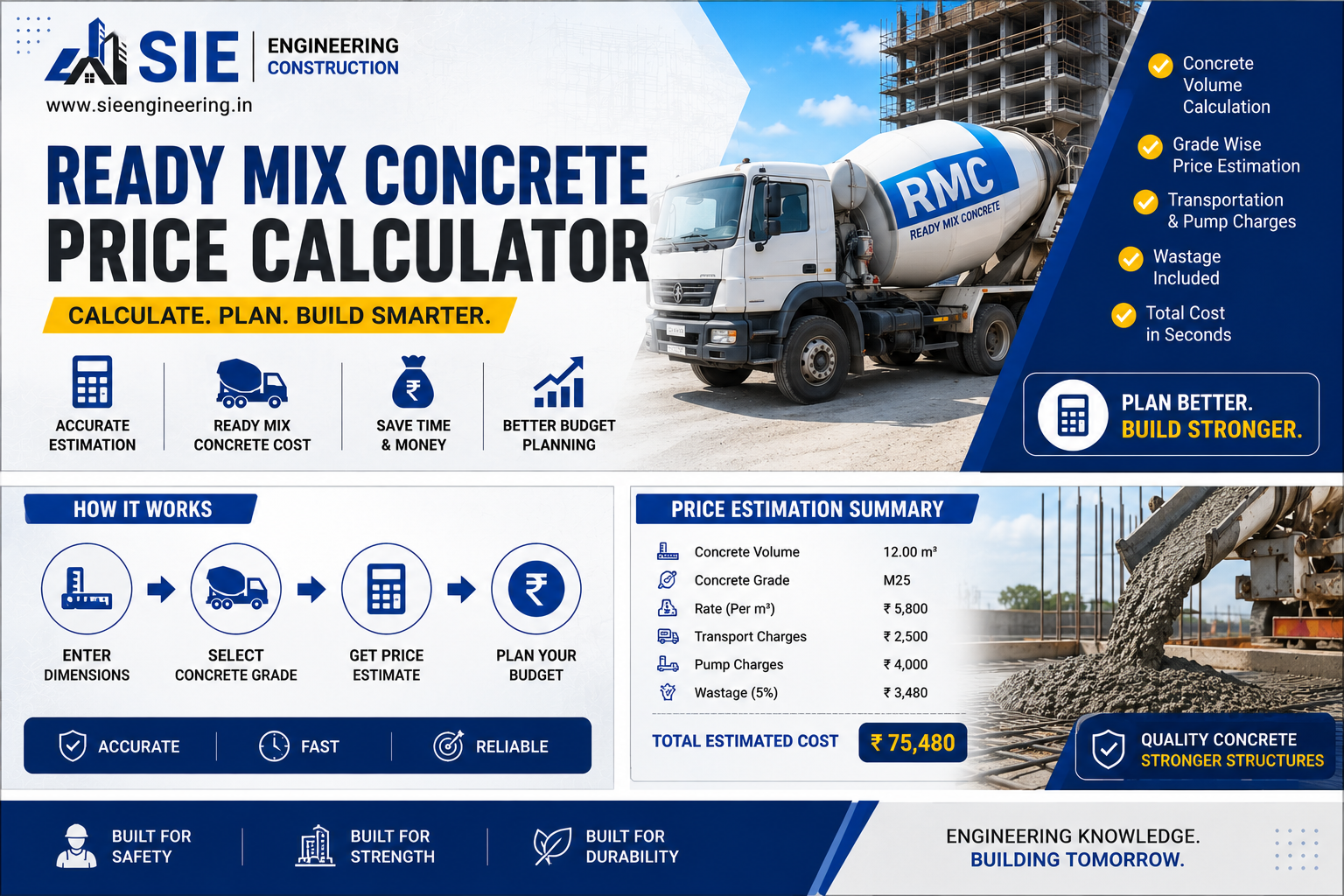
Ready Mix Concrete Cost Calculator PRO
Calculate Ready Mix Concrete quantity, transit mixer trips, pumping cost and total project cost.
Concrete Dimensions
Concrete Details
Engineering Formula
Concrete Volume = Length × Width × Thickness
Total Cost = Concrete Cost + Pumping Cost
5% extra concrete added for wastage and uneven surface.
Sand Quantity Calculator
Use this calculator to estimate sand required for concrete based on volume and mix ratio. Enter volume in cubic meters.
How this works
Sand is calculated using:
Dry Volume = Wet Volume × 1.54
Sand = (Sand Ratio / Total Ratio) × Dry Volume
Result is shown in cubic meters (m³) and cubic feet (ft³).
Aggregate Quantity Calculator
Use this calculator to estimate coarse aggregate required for concrete. Enter volume in cubic meters and select mix grade.
How this works
Aggregate is calculated using:
Dry Volume = Wet Volume × 1.54
Aggregate = (Aggregate Ratio / Total Ratio) × Dry Volume
Result is shown in cubic meters (m³) and cubic feet (ft³).
Water Requirement Calculator (W/C Ratio)
Calculate water required for concrete using cement quantity and W/C ratio.
Formula Used
Water = Cement Weight × W/C Ratio
1 bag cement = 50 kg
1 kg water = 1 litre
Pro Tip (Very Important)
The water-cement ratio directly affects concrete strength and durability.
- PCC: 0.6 – 0.7
- RCC: 0.4 – 0.5
- High Strength: 0.3 – 0.4
RCC Column Cost Calculator
Estimate the cost of RCC column including concrete and steel. Enter dimensions in meters.
How this works
Volume = Height × Width × Depth
Steel ≈ 120 kg per m³
Total Cost = Concrete Cost + Steel Cost
RCC Slab Cost Calculator
Estimate the cost of RCC slab including concrete and steel. Enter dimensions in meters.
How this works
Volume = Length × Width × Thickness
Steel ≈ 80 kg per m³ (slab)
Total Cost = Concrete Cost + Steel Cost
Concrete Footing Calculator
Estimate concrete required for column footings used in house foundations.
Staircase Concrete Calculator PRO
Calculate staircase concrete volume, cement, sand, aggregate, water, steel and total construction cost.
Material Rates
Formula Used
Stair Length = √[(Total Rise²) + (Total Tread²)]
Concrete Volume = Length × Width × Thickness
Dry Volume = Wet Volume × 1.54
Retaining Wall Concrete Calculator PRO
Estimate concrete, cement, sand, aggregate, steel and retaining wall construction cost.
Wall Dimensions
Footing Dimensions
Material Rates
Engineering Formula
Wall Volume = Length × Height × Thickness
Footing Volume = Length × Footing Width × Footing Thickness
Total Concrete = Wall + Footing
Ready Mix Concrete Cost Calculator PRO
Calculate Ready Mix Concrete quantity, transit mixer trips, pumping cost and total project cost.
Concrete Dimensions
Concrete Details
Engineering Formula
Concrete Volume = Length × Width × Thickness
Total Cost = Concrete Cost + Pumping Cost
5% extra concrete added for wastage and uneven surface.
Concrete Weight Calculator PRO
Calculate concrete weight, density, dead load and truck load estimation.
Concrete Dimensions
Engineering Formula
Concrete Volume = Length × Width × Thickness
Concrete Weight = Volume × Density
Typical RCC concrete density = 2400 kg/m³
Concrete Strength Gain Calculator
Track concrete curing strength, estimated MPa gain, and structural readiness using professional engineering standards.
Standard Strength Gain Reference
1 Day
16%
3 Days
40%
7 Days
65%
14 Days
90%
28 Days
99%
Concrete Curing Time Estimator
Estimate concrete strength gain based on curing days.
Advanced Cement Consumption Calculator
Estimate cement consumption for different construction works. This tool helps contractors, engineers and homeowners calculate material quantities before starting construction.
Typical Cement Consumption
| Construction Work | Cement Consumption |
|---|---|
| M20 Concrete | 7 Bags / m³ |
| Brickwork | 0.30 Bags / m² |
| 12 mm Plaster | 0.18 Bags / m² |
| Floor Screed | 0.25 Bags / m² |
Concrete Volume Calculator
Calculate concrete volume, cement bags, truck loads, weight and cost instantly.
Select Concrete Structure
Estimated Results
Cubic Feet
0
Cubic Yards
0
Cement Bags
0
Truck Loads
0
Estimated Weight
0 kg
Total Cost
0
Ready Mix Concrete Price Calculator
The Ultimate Guide to Estimating RMC Cost Accurately
Ready mix concrete has completely changed the modern construction industry. From residential houses to large commercial buildings, almost every major project today depends on high-quality ready mix concrete for faster construction, better strength, and improved quality control.
But before ordering concrete, one of the most common questions people ask is:
“How much will ready mix concrete cost?”
That is where a ready mix concrete price calculator becomes extremely useful.
A ready mix concrete price calculator helps engineers, contractors, builders, and homeowners estimate the total concrete cost based on volume, concrete grade, transportation, pumping charges, labour, and wastage.
Accurate cost estimation is important because concrete forms a major portion of construction expenses. Even small errors in estimation can increase project costs significantly.
In this detailed guide, we will explain everything about ready mix concrete pricing, calculation methods, factors affecting cost, and how to estimate RMC quantity accurately.
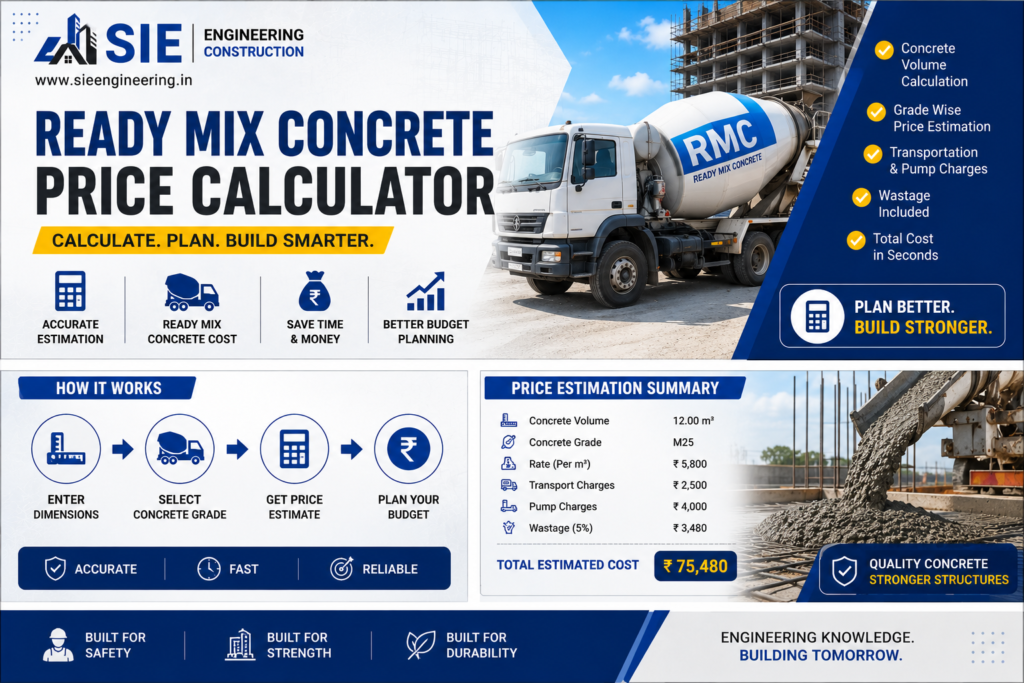
What is Ready Mix Concrete?
Ready mix concrete, commonly called RMC, is concrete manufactured in a batching plant under controlled conditions and delivered to construction sites using transit mixer trucks.
Unlike manual site mixing, ready mix concrete offers:
- Better quality control
- Uniform concrete strength
- Faster construction
- Reduced labour requirement
- Lower material wastage
Today, ready mix concrete is widely used in:
- Residential houses
- Apartments
- Commercial buildings
- Bridges
- Highways
- Industrial projects
- Retaining walls
- RCC slabs
- Columns and beams
What is a Ready Mix Concrete Price Calculator?
A ready mix concrete price calculator is a digital construction estimation tool used to calculate the approximate cost of ready mix concrete required for a project.
The calculator estimates:
- Concrete volume
- Concrete grade cost
- Pumping charges
- Transportation cost
- Labour charges
- Wastage allowance
- Total concrete expense
Modern calculators also provide:
- Cement quantity
- Sand quantity
- Aggregate quantity
- Number of transit mixers
- Cost per square foot
- Project-wise estimation
Why the Ready Mix Concrete Price Calculator is Important?
Concrete is one of the largest expenses in RCC construction.
Incorrect estimation can lead to:
- Material shortage during casting
- Extra concrete wastage
- Budget overruns
- Construction delays
- Additional transportation charges
A proper ready mix concrete price calculator helps avoid these problems.
Main Benefits of Using a Ready Mix Concrete Price Calculator
Accurate Budget Planning
Builders can estimate concrete cost before starting work.
Better Material Management
Avoids over-ordering and under-ordering.
Faster Construction Planning
Concrete supply can be scheduled properly.
Reduced Wastage
Improves construction efficiency.
Better Project Control
Helps monitor material and labour expenses.
What Affects Ready Mix Concrete Price?
Several factors influence the cost of ready mix concrete.
Concrete Grade
Higher concrete grades require more cement and better quality control.
| Grade | Common Use |
|---|---|
| M10 | PCC works |
| M15 | Flooring |
| M20 | Residential RCC |
| M25 | Structural RCC |
| M30 | Commercial buildings |
| M35+ | Heavy structural works |
Higher grade concrete costs more.
Concrete Volume
Larger quantity orders usually reduce per cubic meter transportation cost.
Cement Content
Concrete with higher cement content becomes more expensive.
Transportation Distance
The farther the batching plant is from the site, the higher the transportation cost.
Pumping Charges
If concrete pumps are required, additional charges apply.
Site Accessibility
Difficult access roads may increase transit mixer expenses.
Labour Cost
Some projects include labour charges in concrete pricing.
Concrete Admixtures
Chemical admixtures for waterproofing or strength enhancement increase cost.
How Ready Mix Concrete Volume is Calculated
The basic formula for concrete calculation is:
Concrete Volume = Length × Width × ThicknessThe result is measured in cubic meters.
Example of Ready Mix Concrete Price Calculator Calculations
Suppose you are casting an RCC slab.
| Item | Value |
|---|---|
| Length | 10 m |
| Width | 8 m |
| Thickness | 0.15 m |
Step 1 – Calculate Concrete Volume
Volume = Length × Width × Thickness= 10 × 8 × 0.15
= 12 m³Therefore:
Concrete Required = 12 Cubic Meters
Step 2 – Add Wastage
Construction sites usually require extra concrete due to:
- Spillage
- Uneven formwork
- Transit loss
- Pump line wastage
Recommended extra concrete:
3% to 5%For 5% wastage:
12 × 1.05
= 12.6 m³
Final order quantity:
12.6 m³
Average Ready Mix Concrete Price
Ready mix concrete prices vary depending on location and concrete grade.
Approximate Indian market rates:
| Grade | Approx Price/m³ |
|---|---|
| M10 | ₹4200 – ₹4800 |
| M15 | ₹4500 – ₹5200 |
| M20 | ₹5000 – ₹6000 |
| M25 | ₹5500 – ₹6500 |
| M30 | ₹6200 – ₹7200 |
Prices may vary depending on:
- City
- Cement brand
- Fuel cost
- Aggregate availability
- Transportation distance
Example of RMC Price Calculation
Suppose:
| Item | Value |
|---|---|
| Concrete Quantity | 12.6 m³ |
| Concrete Grade | M20 |
| RMC Rate | ₹5500/m³ |
Concrete Cost
12.6 × 5500
= ₹69,300
Pumping Charges
Suppose pump charge:
₹8,000Total Cost ₹69,300 + ₹8,000
= ₹77,300Final estimated ready mix concrete cost:
₹77,300
Advantages of Ready Mix Concrete
Ready mix concrete offers several advantages over manual mixing.
Better Concrete Quality
Produced in computerized batching plants.
Faster Construction
Concrete arrives ready for immediate pouring.
Reduced Labour Requirement
No need for on-site manual mixing.
Consistent Strength
Proper proportioning improves structural quality.
Reduced Material Wastage
Controlled batching minimizes losses.
Cleaner Construction Site
Less storage of raw materials on site.
Where Ready Mix Concrete is Commonly Used
Ready mix concrete is widely used in:
- RCC slabs
- Columns
- Beams
- Footings
- Retaining walls
- Staircases
- Industrial flooring
- Bridges
- Commercial projects
Ready Mix Concrete for Residential Buildings
Residential projects increasingly use ready mix concrete because it:
- Saves time
- Improves quality
- Reduces labour
- Speeds up slab casting
Small residential buildings often use M20 or M25 grade concrete.
Ready Mix Concrete for Commercial Buildings
Commercial projects require large concrete quantities.
Advantages include:
- Faster project completion
- Better structural performance
- Large-scale pouring capability
- Improved project management
Transit Mixer Capacity
Concrete is usually delivered in transit mixer trucks.
Common capacities:
| Transit Mixer | Capacity |
|---|---|
| Small Mixer | 4 m³ |
| Standard Mixer | 6 m³ |
| Large Mixer | 8 m³ |
Concrete Pump Types
Different pumps are used depending on project size.
Line Pump
Used for small residential projects.
Boom Pump
Used for high-rise buildings and large projects.
Common Mistakes in Ready Mix Concrete Estimation
Ignoring Wastage
Always add extra quantity.
Wrong Concrete Grade Selection
Improper grade affects strength and cost.
Ignoring Pumping Charges
Pump cost can significantly affect total expense.
Incorrect Dimension Measurement
Wrong dimensions create inaccurate estimation.
Not Checking Transit Distance
Long distances increase transportation cost.
Importance of Concrete Grade Selection
Selecting the correct grade is extremely important.
Low-grade concrete may cause:
- Cracks
- Structural weakness
- Durability problems
Higher grades provide:
- Better strength
- Improved durability
- Better load resistance
Importance of Concrete Slump
Slump measures concrete workability.
Higher slump improves flowability but excessive water reduces strength.
Proper slump depends on:
- Structural member
- Pumping method
- Weather condition
Concrete Curing After Pouring
Concrete curing is extremely important.
Proper curing:
- Increases strength
- Prevents cracks
- Improves durability
- Enhances water resistance
Minimum curing duration:
7 to 14 daysReady Mix Concrete vs Site Mix Concrete
| Ready Mix Concrete | Site Mix Concrete |
|---|---|
| Factory produced | Mixed manually |
| Better quality | Quality variation |
| Faster | Slower |
| Less labour | More labour |
| Lower wastage | Higher wastage |
Ready mix concrete is generally preferred for modern construction.
Importance of Reinforcement in RCC
Concrete is strong in compression but weak in tension.
Steel reinforcement provides:
- Tensile strength
- Crack resistance
- Structural stability
RCC structures combine:
- Concrete strength
- Steel flexibility
Why Contractors Prefer Ready Mix Concrete
Most professional contractors prefer ready-mix concrete because:
- Work becomes faster
- Quality improves
- Labour dependency reduces
- Large pours become easier
It is especially useful for:
- Large slabs
- Commercial buildings
- Multi-storey projects
Environmental Benefits of Ready Mix Concrete
Ready-mix concrete also helps reduce environmental impact.
Benefits include:
- Lower dust pollution
- Better material utilization
- Reduced cement wastage
- Controlled production
Modern batching plants are more environmentally efficient than manual site mixing.
Digital Construction and Smart Calculators
The construction industry is becoming increasingly digital.
Modern ready mix concrete calculators now provide:
- Instant estimation
- Cost analysis
- Material planning
- BOQ generation
- Mobile optimization
These tools improve project efficiency significantly.
Why SIE Engineering Construction Uses Smart Estimation Tools
SIE Engineering Construction uses advanced digital estimation methods for:
- RCC construction
- Concrete quantity estimation
- Building planning
- Structural works
- Interior projects
- Construction management
Digital construction tools help improve:
- Accuracy
- Project planning
- Client transparency
- Cost control
Future of Ready Mix Concrete Price Calculator
Future construction estimation systems may include:
- AI-based quantity estimation
- Automatic BOQ generation
- Real-time material pricing
- Smart project analysis
- Voice-enabled estimation
Construction technology is rapidly evolving.
Tips for Ordering Ready Mix Concrete
Measure Properly
Double-check all dimensions.
Add Wastage Allowance
Always order slightly extra concrete.
Confirm Pump Requirement
Pump charges should be planned earlier.
Check Concrete Grade
Use engineer-approved grade.
Coordinate Delivery Timing
Avoid delays during concrete pouring.
A ready mix concrete price calculator is one of the most useful tools in modern construction planning.
Whether you are constructing:
- Residential houses
- RCC slabs
- Commercial buildings
- Retaining walls
- Industrial projects
An accurate ready mix concrete price calculator helps save:
- Time
- Money
- Labour
- Construction materials
It also improves budgeting, project planning, and construction quality.
Instead of depending on rough assumptions, using a professional ready mix concrete price calculator gives builders, contractors, and homeowners better control over project expenses and concrete management.
As modern construction continues becoming smarter and faster, digital concrete estimation tools are becoming essential for every construction project.