
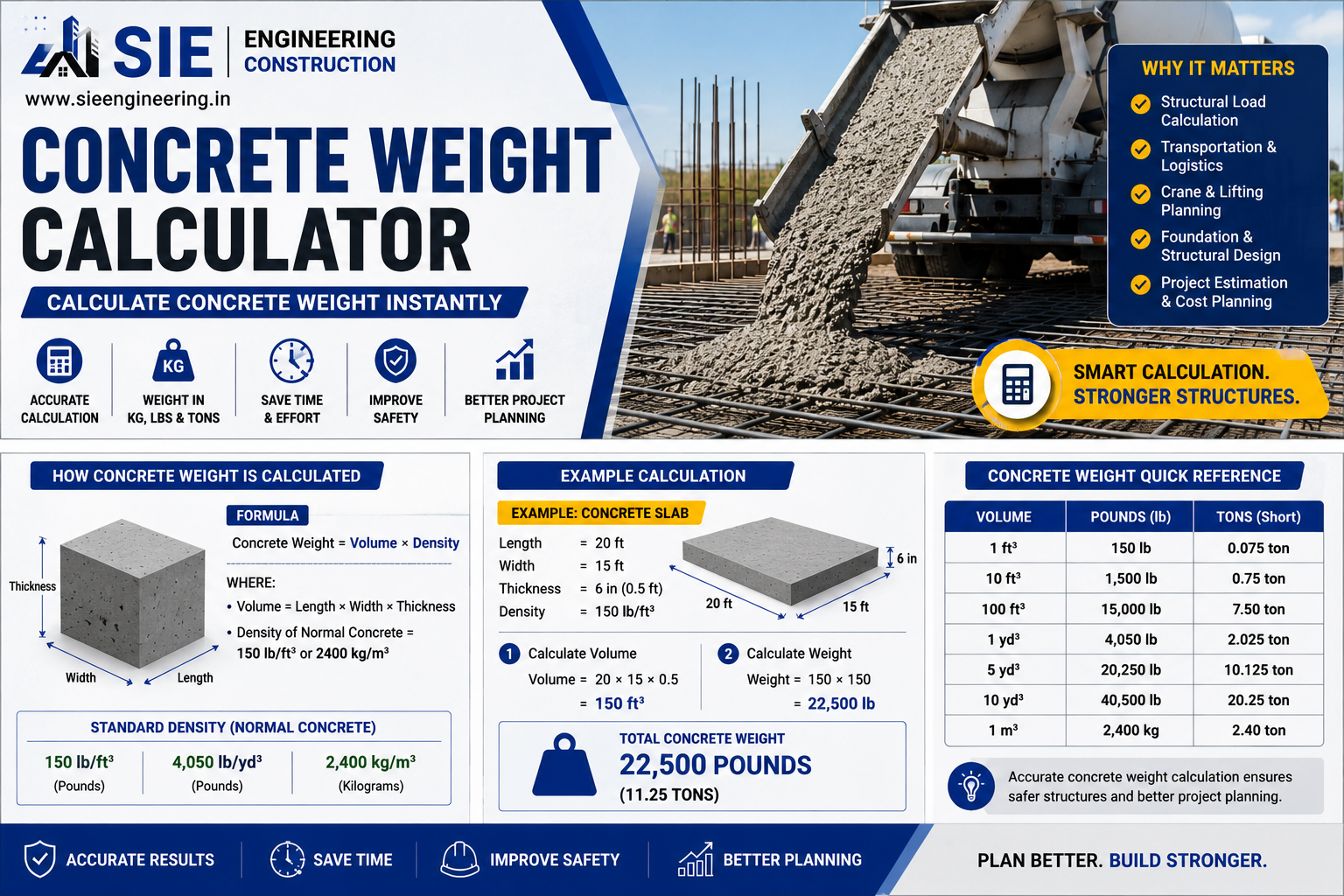
Concrete Weight Calculator PRO
Calculate concrete weight, density, dead load and truck load estimation.
Concrete Dimensions
Engineering Formula
Concrete Volume = Length × Width × Thickness
Concrete Weight = Volume × Density
Typical RCC concrete density = 2400 kg/m³
Sand Quantity Calculator
Use this calculator to estimate sand required for concrete based on volume and mix ratio. Enter volume in cubic meters.
How this works
Sand is calculated using:
Dry Volume = Wet Volume × 1.54
Sand = (Sand Ratio / Total Ratio) × Dry Volume
Result is shown in cubic meters (m³) and cubic feet (ft³).
Aggregate Quantity Calculator
Use this calculator to estimate coarse aggregate required for concrete. Enter volume in cubic meters and select mix grade.
How this works
Aggregate is calculated using:
Dry Volume = Wet Volume × 1.54
Aggregate = (Aggregate Ratio / Total Ratio) × Dry Volume
Result is shown in cubic meters (m³) and cubic feet (ft³).
Water Requirement Calculator (W/C Ratio)
Calculate water required for concrete using cement quantity and W/C ratio.
Formula Used
Water = Cement Weight × W/C Ratio
1 bag cement = 50 kg
1 kg water = 1 litre
Pro Tip (Very Important)
The water-cement ratio directly affects concrete strength and durability.
- PCC: 0.6 – 0.7
- RCC: 0.4 – 0.5
- High Strength: 0.3 – 0.4
RCC Column Cost Calculator
Estimate the cost of RCC column including concrete and steel. Enter dimensions in meters.
How this works
Volume = Height × Width × Depth
Steel ≈ 120 kg per m³
Total Cost = Concrete Cost + Steel Cost
RCC Slab Cost Calculator
Estimate the cost of RCC slab including concrete and steel. Enter dimensions in meters.
How this works
Volume = Length × Width × Thickness
Steel ≈ 80 kg per m³ (slab)
Total Cost = Concrete Cost + Steel Cost
Concrete Footing Calculator
Estimate concrete required for column footings used in house foundations.
Staircase Concrete Calculator PRO
Calculate staircase concrete volume, cement, sand, aggregate, water, steel and total construction cost.
Material Rates
Formula Used
Stair Length = √[(Total Rise²) + (Total Tread²)]
Concrete Volume = Length × Width × Thickness
Dry Volume = Wet Volume × 1.54
Retaining Wall Concrete Calculator PRO
Estimate concrete, cement, sand, aggregate, steel and retaining wall construction cost.
Wall Dimensions
Footing Dimensions
Material Rates
Engineering Formula
Wall Volume = Length × Height × Thickness
Footing Volume = Length × Footing Width × Footing Thickness
Total Concrete = Wall + Footing
Ready Mix Concrete Cost Calculator PRO
Calculate Ready Mix Concrete quantity, transit mixer trips, pumping cost and total project cost.
Concrete Dimensions
Concrete Details
Engineering Formula
Concrete Volume = Length × Width × Thickness
Total Cost = Concrete Cost + Pumping Cost
5% extra concrete added for wastage and uneven surface.
Concrete Weight Calculator PRO
Calculate concrete weight, density, dead load and truck load estimation.
Concrete Dimensions
Engineering Formula
Concrete Volume = Length × Width × Thickness
Concrete Weight = Volume × Density
Typical RCC concrete density = 2400 kg/m³
Concrete Strength Gain Calculator
Track concrete curing strength, estimated MPa gain, and structural readiness using professional engineering standards.
Standard Strength Gain Reference
1 Day
16%
3 Days
40%
7 Days
65%
14 Days
90%
28 Days
99%
Concrete Curing Time Estimator
Estimate concrete strength gain based on curing days.
Advanced Cement Consumption Calculator
Estimate cement consumption for different construction works. This tool helps contractors, engineers and homeowners calculate material quantities before starting construction.
Typical Cement Consumption
| Construction Work | Cement Consumption |
|---|---|
| M20 Concrete | 7 Bags / m³ |
| Brickwork | 0.30 Bags / m² |
| 12 mm Plaster | 0.18 Bags / m² |
| Floor Screed | 0.25 Bags / m² |
Concrete Volume Calculator
Calculate concrete volume, cement bags, truck loads, weight and cost instantly.
Select Concrete Structure
Estimated Results
Cubic Feet
0
Cubic Yards
0
Cement Bags
0
Truck Loads
0
Estimated Weight
0 kg
Total Cost
0
Concrete Weight Calculator
Calculate Concrete Weight Instantly for Slabs, Footings, Columns & Walls
A Concrete Weight Calculator helps you estimate how much concrete weighs based on volume and density. Whether you are pouring a driveway, slab, footing, column, retaining wall, or foundation, knowing the exact concrete weight is extremely important for structural design, transportation, lifting, and project planning.
Concrete is one of the heaviest construction materials used in modern building projects. Even a small slab can weigh several tons. Because of this, engineers, contractors, and homeowners often use a Concrete Weight Calculator before starting construction work.
This guide explains how concrete weight is calculated, why it matters, and how to estimate concrete weight correctly using practical examples and formulas.
What is a Concrete Weight Calculator?
A Concrete Weight Calculator is a construction estimation tool used to calculate the total weight of concrete based on dimensions and density.
The calculator can estimate:
- Concrete weight in pounds
- Concrete weight in kilograms
- Concrete weight in tons
- Concrete volume
- Dead load of structures
- Material handling weight
A Concrete total Weight Calculator is commonly used by:
- Contractors
- Civil engineers
- Structural engineers
- Builders
- Construction companies
- Homeowners
Why Concrete Weight Calculation Matters
Concrete weight plays a major role in construction planning and structural safety.
Incorrect weight estimation may lead to:
- Structural overloading
- Crane lifting problems
- Transportation overload
- Foundation issues
- Unsafe construction practices
Using a Concrete Weight Calculators helps avoid these issues and improves project accuracy.
Standard Concrete Weight
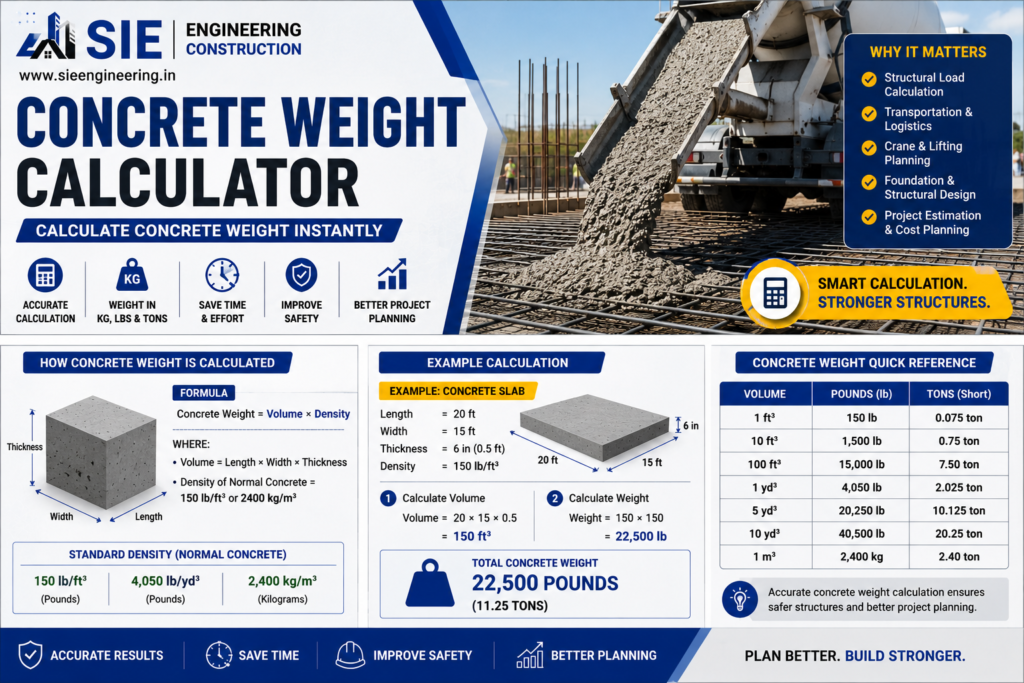
The average weight of normal concrete is:
| Unit | Weight |
|---|---|
| 1 cubic foot | 150 lbs |
| 1 cubic yard | 4050 lbs |
| 1 cubic meter | 2400 kg |
These values are commonly used in a Concrete total Weight Calculator.
Concrete Weight Formula
The basic formula used in a Concrete Calculator is:
Concrete Weight = Volume × DensityWhere:
- Volume = length × width × thickness
- Density of normal concrete = 150 lbs/ft³ or 2400 kg/m³
Concrete Calculator Example
Suppose you are casting a concrete slab.
| Item | Value |
|---|---|
| Length | 20 ft |
| Width | 15 ft |
| Thickness | 6 inches |
Step 1 – Convert Thickness
6 inches = 0.5 feetStep 2 – Calculate Volume
Volume = Length × Width × Thickness= 20 × 15 × 0.5
= 150 cubic feetStep 3 – Calculate Weight
Using standard concrete density:
Weight = 150 × 150
= 22,500 lbs
Final result:
Concrete Weight = 22,500 Pounds
A Concrete Calculator performs this calculation instantly.
Concrete Weight by Cubic Foot
One cubic foot of concrete weighs approximately:
150 Pounds
This value may vary slightly depending on:
- Moisture content
- Aggregate type
- Reinforcement
- Concrete mix
Concrete Weight by Cubic Yard
A cubic yard contains 27 cubic feet.
Therefore:
27 × 150 = 4050 lbs1 Cubic Yard Concrete = 4050 Pounds
This is one of the most searched terms related to a Concrete Weight Calculator.
Concrete Weight by Cubic Meter
For metric calculations:
1 Cubic Meter Concrete = 2400 kg
This value is commonly used in RCC construction and structural engineering.
Concrete Weight for Slabs
Concrete slabs are one of the most common uses of a Concrete Weight Calculator.
Example:
| Slab Size | Value |
|---|---|
| Length | 30 ft |
| Width | 20 ft |
| Thickness | 5 inches |
Convert thickness:
5 inches = 0.417 ftVolume:
30 × 20 × 0.417
= 250.2 cubic feet
Weight:
250.2 × 150
= 37,530 lbs
Final result:
Slab Weight = 37,530 Pounds
Concrete Weight Calculator for Footings
Footings support structural loads and require accurate weight estimation.
Example:
| Footing Size | Value |
|---|---|
| Length | 8 ft |
| Width | 8 ft |
| Thickness | 1.5 ft |
Volume:
8 × 8 × 1.5
= 96 cubic feet
Weight:
96 × 150
= 14,400 lbs
Footing Weight = 14,400 Pounds
A Concrete Weight Calculator helps estimate footing loads accurately.
Concrete Weight Calculator for Driveways
Driveways often require large concrete pours.
Example:
| Driveway Size | Value |
|---|---|
| Length | 40 ft |
| Width | 12 ft |
| Thickness | 4 inches |
Volume:
40 × 12 × 0.333
= 159.84 cubic feet
Weight:
159.84 × 150
= 23,976 lbs
Driveway Weight = 23,976 Pounds
Concrete Weight Calculator for Columns
Columns carry structural loads from beams and slabs.
Example:
| Column Size | Value |
|---|---|
| Height | 10 ft |
| Width | 1 ft |
| Depth | 1 ft |
Volume:
10 × 1 × 1
= 10 cubic feet
Weight:
10 × 150
= 1500 lbs
Column Weight = 1500 Pounds
Concrete Weight Calculator for Retaining Walls
Retaining walls rely heavily on self-weight for stability.
A Concrete Weight Calculator helps determine:
- Sliding resistance
- Overturning resistance
- Structural stability
This is extremely important in retaining wall design.
Concrete Weight Calculator for Precast Concrete
Precast concrete elements are manufactured off-site and transported to projects.
Examples include:
- Precast panels
- Drain covers
- Concrete pipes
- Wall blocks
- Beams
A Concrete Weight Calculator helps determine:
- Crane capacity
- Transportation requirements
- Lifting safety
Lightweight Concrete Weight
Lightweight concrete weighs less than standard concrete.
Typical density:
| Concrete Type | Weight |
|---|---|
| Lightweight Concrete | 90–115 lbs/ft³ |
| Normal Concrete | 150 lbs/ft³ |
| Heavyweight Concrete | 300+ lbs/ft³ |
A Concrete Weight Calculator may include different density options depending on project requirements.
Heavyweight Concrete Weight
Heavyweight concrete is used in:
- Nuclear facilities
- Radiation shielding
- Industrial structures
It can weigh:
300–400 lbs per cubic foot
A specialized Concrete Weight Calculator is often required for these projects.
Why Engineers Use a Concrete Weight Calculator
Structural engineers regularly use a Concrete Weight Calculator because concrete contributes major dead load to buildings.
It helps calculate:
- Beam load
- Slab load
- Column load
- Foundation pressure
- Structural stability
Without accurate weight estimation, structural design may become unsafe.
Why Contractors Use a Concrete Weight Calculator
Contractors use a Concrete Weight Calculator for:
- Equipment planning
- Concrete transportation
- Site logistics
- Crane operation
- Material management
It improves efficiency and reduces costly mistakes.
Concrete Weight and Reinforcement Steel
Reinforced concrete includes steel bars.
Steel increases total structure weight significantly.
Approximate reinforcement percentage:
1% to 3%Advanced Concrete Weight Calculator tools may also estimate steel weight separately.
Concrete Weight Conversion Table
| Concrete Volume | Approx Weight |
|---|---|
| 1 ft³ | 150 lbs |
| 10 ft³ | 1500 lbs |
| 100 ft³ | 15,000 lbs |
| 1 yd³ | 4050 lbs |
| 5 yd³ | 20,250 lbs |
A Concrete Weight Calculator automates these calculations instantly.
Common Mistakes in Concrete Weight Calculation
Incorrect Thickness Conversion
Many people forget to convert inches into feet.
Wrong Density Value
Different concrete mixes have different densities.
Ignoring Reinforcement Weight
Steel reinforcement adds extra weight.
Mixing Units
Combining metric and imperial units creates major errors.
No Safety Margin
Practical construction always requires additional allowance.
Concrete Weight Calculator for Residential Projects
Homeowners commonly use a Concrete Weight Calculator for:
- Patios
- Driveways
- Slabs
- Foundations
- Garage floors
It helps estimate transportation and project cost more accurately.
Concrete Weight Calculator for Commercial Construction
Commercial projects contain massive concrete quantities.
Accurate weight estimation helps:
- Structural design
- Crane planning
- Foundation analysis
- Material handling
Large commercial buildings rely heavily on accurate concrete load calculation.
Importance of Dead Load Calculation
Concrete weight forms a major part of building dead load.
Dead load includes:
- Slab weight
- Beam weight
- Wall weight
- Column weight
- Floor finish weight
Structural engineers use a Concrete Weight Calculator during building analysis.
Transportation and Concrete Weight
Concrete is extremely heavy.
Incorrect estimation may cause:
- Truck overloading
- Road safety issues
- Transportation fines
- Equipment failure
A Concrete Weight Calculator helps determine safe transportation limits.
Modern Construction and Smart Calculators
Modern construction increasingly depends on digital tools.
Today’s Concrete Weight Calculator tools provide:
- Instant results
- Mobile compatibility
- Imperial and metric conversion
- Cost estimation
- Material analysis
These tools save time and improve project accuracy.
Why SIE Engineering Construction Uses Smart Estimation Tools
SIE Engineering Construction uses advanced digital estimation systems for:
- RCC construction
- Structural planning
- Concrete quantity estimation
- Building construction
- Material management
Digital construction tools improve:
- Accuracy
- Budget planning
- Site efficiency
- Client transparency
Future of Concrete Weight Calculation
Future construction technology may include:
- AI-based structural analysis
- Smart load prediction
- Automated BOQ generation
- Real-time density estimation
- Voice-enabled calculators
The construction industry is becoming increasingly digital.
Tips for Accurate Concrete Weight Estimation
Measure Dimensions Carefully
Always double-check slab thickness and dimensions.
Use Correct Density
Different concrete types have different weights.
Include Reinforcement
Steel increases RCC weight.
Add Safety Margin
Practical construction always needs allowance.
Verify Unit Conversion
Avoid mixing feet, inches, meters, and yards incorrectly.
A Concrete Weight Calculator is one of the most important construction tools used in structural engineering and project planning.
Whether you are building:
- RCC slabs
- Footings
- Driveways
- Retaining walls
- Foundations
- Commercial structures
accurate concrete weight estimation helps improve:
- Structural safety
- Transportation planning
- Crane operation
- Material handling
- Project efficiency
Instead of relying on rough assumptions, using a professional Concrete Weight Calculator gives engineers, contractors, and homeowners better control over construction planning and structural analysis.
As modern construction continues evolving, digital concrete estimation tools are becoming essential for every construction project.