
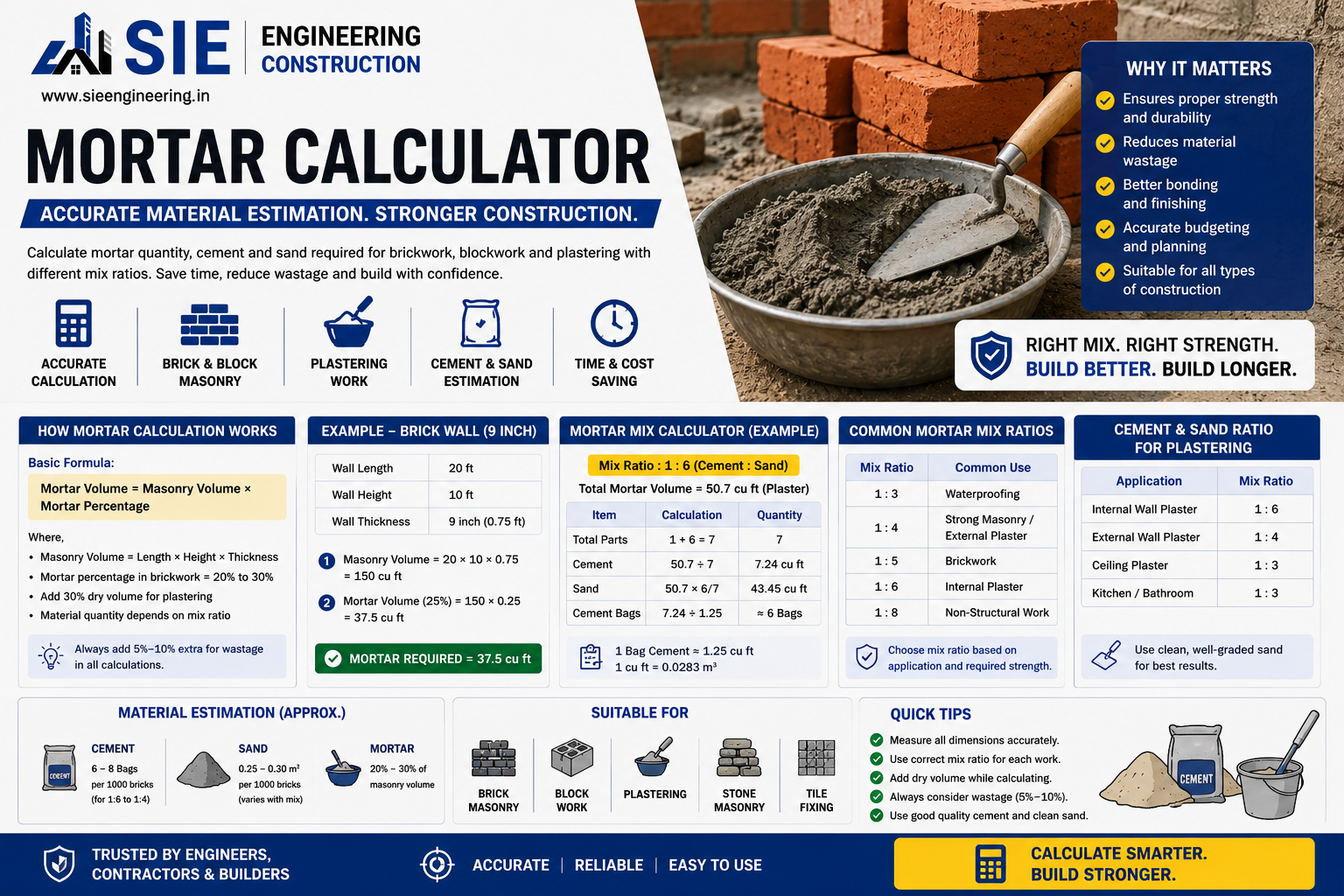
Mortar Requirement Calculator
Estimate mortar quantity, cement bags, and sand requirement for masonry and plaster work.
Standard Mortar Reference
Brickwork Mortar
30%
Dry Volume Factor
1.33
Cement Bag
0.035m³
Mortar Calculator
Complete Guide to Mortar Mix Calculation, Brick Mortar Estimation & Cement Sand Ratios
Mortar is one of the most important materials used in construction. Whether you are building brick walls, plastering surfaces, laying blocks, or installing tiles, proper mortar mixing is essential for strength, durability, and long-term performance.
Before starting masonry or plastering work, one of the most common questions homeowners, contractors, and builders ask is:
“How much mortar do I need?”
That is where a Mortar Calculator becomes extremely useful.
A Mortar Calculator helps estimate the amount of mortar required for brickwork, blockwork, plastering, masonry joints, and construction projects. It also helps calculate cement and sand quantities based on different mortar mix ratios.
This guide explains everything about a Mortar Calculator, including mortar mix calculation, brick mortar estimation, plastering mortar ratios, practical examples, formulas, and construction tips for both USA and global audiences.
What is a Mortar Calculator?
A Mortar Calculator is a construction estimation tool used to calculate:
- Mortar quantity
- Cement quantity
- Sand quantity
- Mortar mix ratio
- Brick mortar requirement
- Plastering mortar estimation
A Mortar Calculator is commonly used by:
- Mason contractors
- Bricklayers
- Civil engineers
- Builders
- Homeowners
- Construction companies
Why Mortar Calculation is Important
Incorrect mortar estimation creates serious construction problems.
Too little mortar may cause:
- Construction delays
- Weak bonding
- Incomplete masonry work
Too much mortar may cause:
- Material wastage
- Increased project cost
- Storage problems
Using a Mortar Calculator helps improve:
- Budget planning
- Material estimation
- Construction efficiency
- Site management
What is Mortar?
Mortar is a mixture of:
- Cement
- Sand
- Water
It is used to bind:
- Bricks
- Concrete blocks
- Stone masonry
- Tiles
Mortar fills gaps between masonry units and provides structural stability.
Main Uses of Mortar
Mortar is widely used for:
- Brick masonry
- Blockwork
- Wall plastering
- Tile fixing
- Stone masonry
- Joint filling
- Pointing work
This helps estimate mortar accurately for all these applications.
Types of Mortar Used in Construction
Different construction works require different mortar types.
Cement Mortar
The most common mortar used worldwide.
Made using:
- Cement
- Sand
- Water
Lime Mortar
Traditional mortar is used in old buildings and restoration projects.
Mud Mortar
Used mainly in rural construction.
Polymer Mortar
Used in high-performance modern construction applications.
What is a Mortar Mix Ratio?
A mortar mix ratio refers to the proportion of cement and sand used in mortar preparation.
Example:
1:4means:
- 1 part cement
- 4 parts sand
A Mortar Mix Calculator helps estimate these quantities accurately.
Common Mortar Mix Ratios
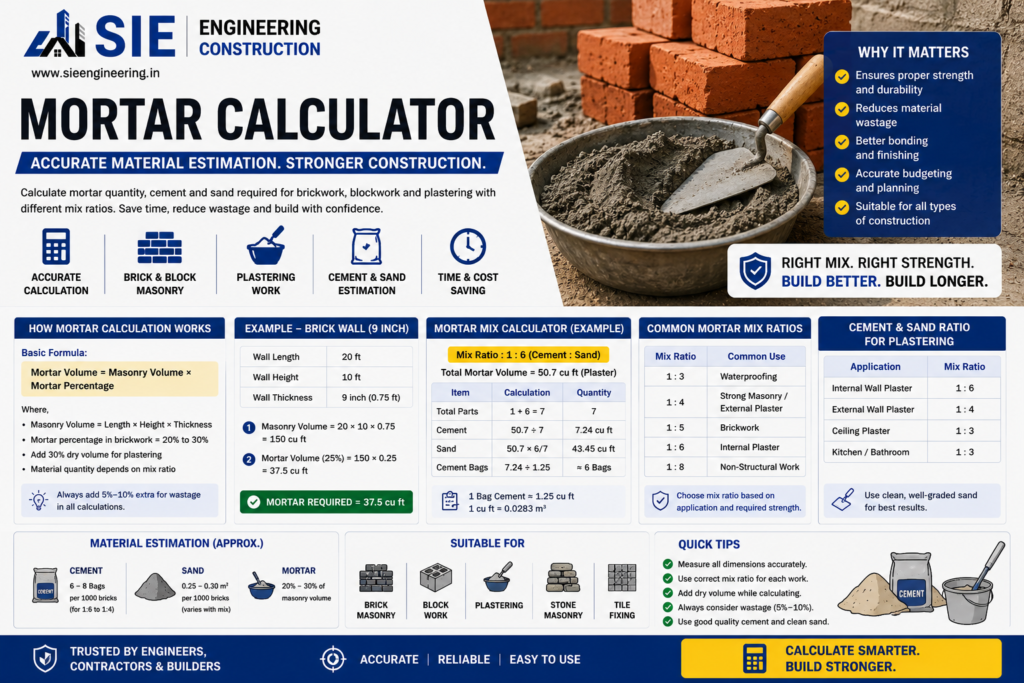
| Mortar Ratio | Common Use |
|---|---|
| 1:3 | Waterproofing |
| 1:4 | Strong masonry |
| 1:5 | Brickwork |
| 1:6 | General plastering |
| 1:8 | Non-structural work |
A Mortar Mix Calculator automatically estimates cement and sand based on these ratios.
Cement and Sand Ratio for Plastering
One of the most searched construction questions is:
Cement and Sand Ratio for Plastering
Different plastering works require different mortar strengths.
Internal Wall Plaster
Common ratio:
1:6External Wall Plaster
Common ratio:
1:4Ceiling Plaster
Typical ratio:
1:3Basic Formula Used in a Mortar Mix Calculator
The basic formula is:
Mortar Volume = Masonry Volume × Mortar PercentageMortar typically occupies:
20% to 30%of brick masonry volume.
Brick Mortar Mix Calculator Example
Suppose you are constructing a brick wall.
| Item | Value |
|---|---|
| Wall Length | 20 ft |
| Wall Height | 10 ft |
| Wall Thickness | 9 inches |
Step 1 – Calculate Wall Volume
Convert thickness:
9 inches = 0.75 feetVolume:
20 × 10 × 0.75
= 150 cubic feet
Step 2 – Estimate Mortar Volume
Assume mortar occupies 25%.
150 × 0.25
= 37.5 cubic feet
Final result:
Mortar Required = 37.5 Cubic Feet
A Brick Mortar Calculator performs this instantly.
Mortar Calculator for Brickwork
A Brick Mortar Calculator helps estimate:
- Mortar volume
- Cement bags
- Sand quantity
- Brick joint mortar
This is extremely useful for:
- Brick walls
- Boundary walls
- Residential houses
- Commercial masonry
Mortar Calculator for Blockwork
Concrete blocks require mortar for joint filling.
A Mortar Calculator helps estimate mortar requirement for:
- AAC blocks
- Hollow blocks
- Solid concrete blocks
Blockwork usually consumes less mortar than brick masonry.
Mortar Calculator for Plastering
Plastering requires accurate mortar estimation to avoid wastage.
A Mortar Calculator helps determine:
- Cement quantity
- Sand quantity
- Mortar thickness
- Plastering area
Example of Plaster Mortar Calculation
Suppose:
| Item | Value |
|---|---|
| Wall Area | 1000 sq ft |
| Plaster Thickness | 12 mm |
Convert thickness:
12 mm = 0.039 ftVolume:
1000 × 0.039
= 39 cubic feet
Add 30% dry volume increase:
39 × 1.3
= 50.7 cubic feet
Final result:
Mortar Volume = 50.7 Cubic Feet
A Mortar Calculator estimates this instantly.
Cement Quantity in Mortar
Cement quantity depends on mortar ratio.
For 1:6 mortar:
Total parts:
1 + 6 = 7Cement proportion:
1/7If total mortar volume is 50.7 cubic feet:
50.7 ÷ 7
= 7.24 cubic feet cement
Approximate cement bags:
7.24 ÷ 1.25
≈ 5.8 bags
Cement Required = 6 Bags
A Mortar Mix Calculator automates this process.
Sand Quantity in Mortar
For 1:6 mortar:
Sand proportion:
6/7Sand quantity:
50.7 × 6/7
= 43.45 cubic feet
Sand Required = 43.45 Cubic Feet
Why Dry Volume is Increased
Dry materials occupy more volume than wet mortar.
Typically:
30% to 35%extra volume is added during calculation.
A Mortar Calculator usually includes this automatically.
Mortar Calculator for USA Audience
In the USA, common searches include:
- mortar calculator
- mortar mix calculator
- brick mortar calculator
- mortar estimator
- masonry mortar calculator
USA users commonly calculate using:
- cubic feet
- cubic yards
- inches
- pounds
Optimizing for these units helps attract Tier 1 traffic.
Mortar Calculator for UK Audience
UK masonry commonly uses:
- square meters
- cubic meters
- plaster ratios
- UK brick standards
Popular UK searches include:
- mortar mix calculator UK
- cement sand ratio calculator
- plaster mortar calculator
Mortar Calculator for India Audience
In India, common searches include:
- cement sand ratio for plastering
- mortar calculator
- brick mortar calculation
- cement quantity for brickwork
Indian construction commonly uses metric units.
Common Mortar Thickness
Approximate mortar thickness:
| Work Type | Thickness |
|---|---|
| Brick Joint | 10 mm |
| Wall Plaster | 12–15 mm |
| Ceiling Plaster | 6–10 mm |
A Mortar Calculator helps estimate based on thickness.
Common Mistakes in Mortar Calculation
Ignoring Dry Volume Increase
Dry materials require extra volume.
Wrong Mix Ratio
An incorrect ratio affects strength.
Improper Unit Conversion
Mixing feet and meters creates errors.
Ignoring Wastage
Construction always includes some wastage.
Incorrect Thickness
Small thickness changes greatly affect mortar quantity.
Why Contractors Use a Mortar Calculator
Professional contractors use a Mortar Calculator because it helps:
- Estimate materials accurately
- Reduce wastage
- Improve budgeting
- Save labour time
- Increase project efficiency
It is one of the most practical construction tools available today.
Mortar Strength and Construction Quality
Proper mortar strength improves:
- Bonding
- Crack resistance
- Wall durability
- Water resistance
Weak mortar may cause:
- Joint failure
- Cracks
- Leakage
- Structural weakness
Mortar Calculator for Masonry Contractors
Masonry contractors use advanced mortar estimation for:
- BOQ preparation
- Material procurement
- Labour planning
- Project scheduling
Digital construction estimation tools improve productivity significantly.
Modern Construction and Smart Calculators
Today’s construction industry increasingly depends on digital tools.
Modern Mortar Calculator systems provide:
- Instant material estimation
- Cement calculation
- Sand calculation
- Ratio analysis
- Mobile compatibility
These tools save time and improve accuracy.
Why SIE Engineering Construction Uses Smart Estimation Tools
SIE Engineering Construction uses advanced digital estimation methods for:
- Brick masonry
- RCC construction
- Mortar estimation
- Material planning
- Quantity analysis
Digital tools improve:
- Cost estimation
- Site management
- Material control
- Project efficiency
Future of Mortar Estimation Technology
Future construction technology may include:
- AI-based mortar analysis
- Automatic BOQ generation
- Smart material tracking
- Voice-enabled calculators
- Real-time site estimation
Construction technology is evolving rapidly.
Tips for Accurate Mortar Estimation
Measure Properly
Always verify dimensions carefully.
Use Correct Mix Ratio
Different applications require different strengths.
Include Dry Volume
Dry materials occupy more space.
Add Wastage Allowance
Practical construction always includes wastage.
Use Standard Thickness
Proper joint thickness improves estimation accuracy.
Final Thoughts
A Mortar Calculator is one of the most useful tools in masonry and construction estimation.
Whether you are working on:
- Brick masonry
- Blockwork
- Plastering
- Wall construction
- Tile work
- Stone masonry
accurate mortar estimation helps improve:
- Budget planning
- Material management
- Construction quality
- Site efficiency
- Labour productivity
Instead of depending on rough assumptions, using a professional Mortar Calculator gives contractors, engineers, builders, and homeowners better control over masonry work and construction planning.
As modern construction continues becoming smarter and more digital, advanced mortar estimation tools are becoming essential for every successful building project.