
AAC Block Calculator for Wall
Calculate AAC block quantity, wall volume, mortar, adhesive and wastage instantly.
Wall Area
0
Wall Volume
0
Mortar Required
0
Adhesive Bags
0
Extra Wastage Blocks
0
Total Blocks With Wastage
0
Brick Quantity Calculator
Estimate brick quantity for 115mm and 230mm brick walls with wastage calculation.
Standard Brick Calculation Reference
115mm Wall
50 Bricks/m²
230mm Wall
100 Bricks/m²
Wastage
5%
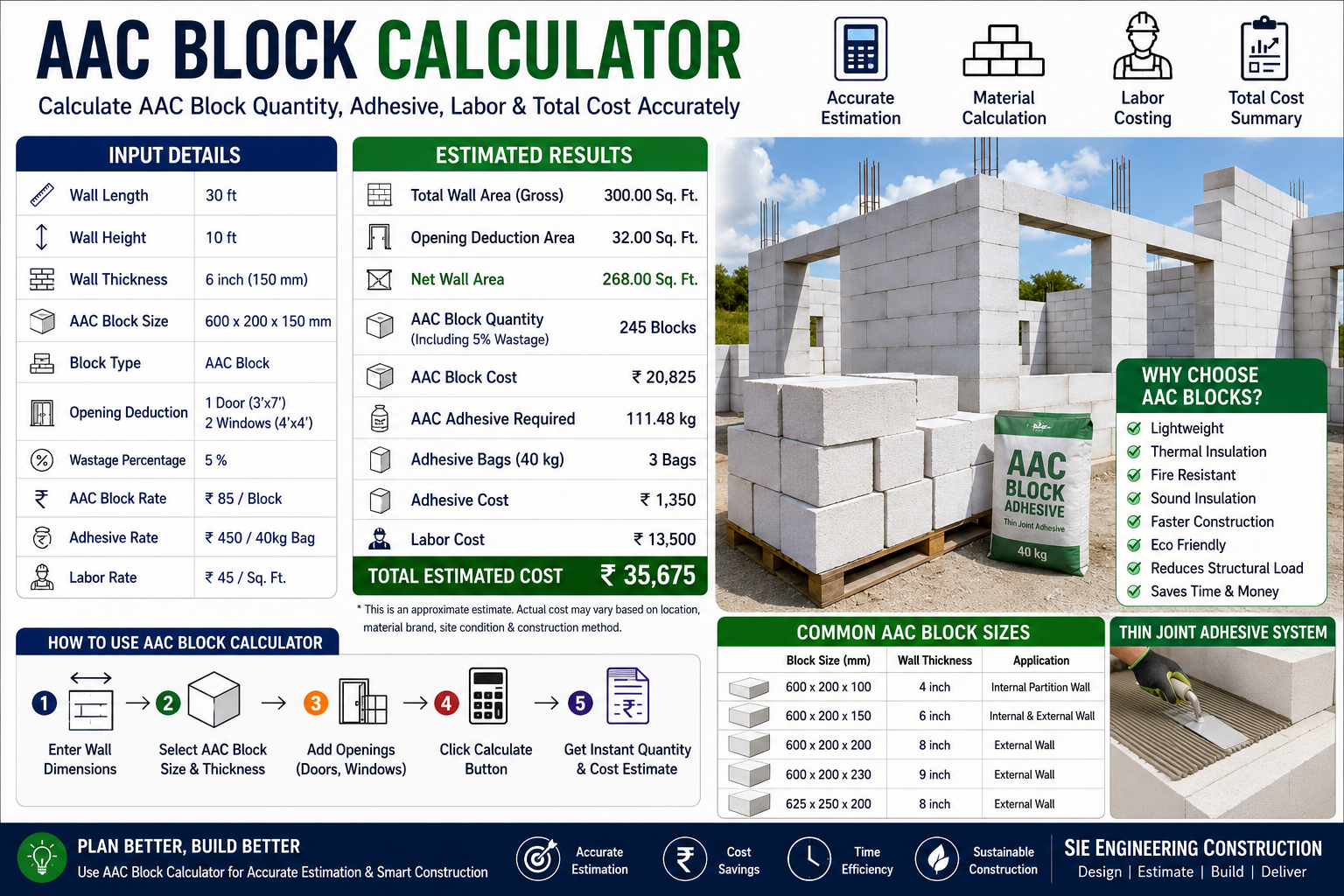
AAC Block Calculator – Complete AAC Block Quantity and Cost Estimation Guide
AAC Block Calculator for Accurate Construction Estimation
An AAC Block Calculator is one of the most important tools for modern construction projects. Builders, contractors, engineers, architects, and homeowners use an AAC Block Calculator to estimate the exact quantity of AAC blocks, block adhesive, mortar, labor cost, and total masonry cost before starting construction work. AAC blocks are becoming increasingly popular worldwide because they are lightweight, thermally efficient, fire-resistant, and environmentally friendly. Due to these advantages, the demand for a professional AAC Block Calculator is increasing rapidly across countries like India, USA, UK, UAE, Canada, Australia, Bangladesh, Nepal, and many European countries.
An AAC Block Calculator helps users calculate the number of blocks required for walls based on wall dimensions, block sizes, wall thickness, and opening deductions. A modern AAC Block Calculator can also estimate adhesive quantity, mortar requirement, labor charges, and total wall construction cost. Without an AAC Block Calculator, construction estimation becomes difficult, time-consuming, and prone to errors.
Traditional brick masonry and AAC block masonry differ significantly. AAC blocks are much larger than conventional bricks, reducing mortar consumption and increasing construction speed. Therefore, a dedicated AAC Block Calculator is essential because brickwork formulas cannot accurately estimate AAC block quantities. An advanced AAC Block Estimator provides faster and more realistic calculations for modern building systems.
The popularity of AAC block construction is growing rapidly due to rising construction costs and energy efficiency requirements. AAC blocks reduce dead load on structures, improve thermal insulation, and lower air conditioning expenses. As a result, engineers and developers increasingly rely on AAC Block Estimator tools for residential, commercial, industrial, and institutional projects.
An AAC Block Calculator is extremely useful for:
residential buildings
apartments
villas
hospitals
schools
offices
warehouses
factories
shopping malls
boundary walls
A professional AAC Block Calculator saves money, reduces wastage, improves material planning, and helps contractors prepare accurate quotations quickly.
What is AAC Block?
AAC stands for Autoclaved Aerated Concrete. AAC blocks are lightweight precast foam concrete building materials manufactured using cement, lime, sand, gypsum, aluminum powder, and water. AAC blocks contain millions of microscopic air pores, making them much lighter than traditional clay bricks.
AAC blocks are widely used because they provide:
excellent thermal insulation
sound insulation
fire resistance
earthquake resistance
lightweight construction
faster installation
reduced structural load
Modern construction projects increasingly prefer AAC blocks over conventional bricks because AAC block walls reduce structural dead load significantly. This reduces steel and concrete consumption in RCC structures.
Due to the increasing use of AAC blocks globally, online AAC Block Calculator tools have become essential for builders and engineers.
How AAC Block Calculator Works
An AAC Block Calculator works using wall dimensions and AAC block dimensions. The user enters wall length, wall height, wall thickness, block size, and opening deductions such as doors and windows. The AAC Block Estimator then calculates wall area and determines how many AAC blocks are required.
A professional Block Calculator also calculates:
block adhesive quantity
mortar quantity
labor charges
wastage percentage
total masonry cost
The AAC Block Estimator first calculates wall volume. Then it divides the wall volume by individual block volume to estimate block quantity. Wastage percentage is added to account for cutting loss and transportation damage.
AAC block adhesive consumption is also calculated based on wall area. Since AAC blocks use thin joint adhesive instead of thick mortar joints, adhesive quantity differs significantly from traditional brick masonry.
An advanced AAC Block Calculator also allows users to select different AAC block sizes used across various countries and construction practices.
Advantages of Using AAC Block Estimator
An AAC Block Calculator offers several advantages for homeowners, contractors, builders, and engineers.
The biggest advantage of an AAC Block Calculator is estimation accuracy. Accurate quantity estimation reduces material wastage and prevents budget overruns.
A Block Calculator saves time compared to manual calculations. Large construction projects require complex quantity estimation, and manual calculations often create errors. A digital Block Calculator performs calculations instantly.
A professional AAC Block Estimator also improves budgeting accuracy. Users understand the approximate construction cost before purchasing materials. This helps homeowners plan their finances better.
Contractors use AAC Block Estimator tools for faster quotation preparation. Quick estimation improves customer response time and increases professionalism.
An AAC Block Estimator also helps optimize transportation planning. AAC blocks occupy large space due to their dimensions. Accurate quantity estimation reduces transportation trips and storage problems.
Modern AAC Block Calculator tools are mobile-friendly, allowing site engineers to perform calculations directly from smartphones and tablets.
Standard AAC Block Sizes Used in AAC Block Calculator
Different countries use different AAC block sizes. Therefore, a professional AAC Block Calculator should support multiple block dimensions.
Common AAC block sizes used globally include:
600 × 200 × 100 mm
600 × 200 × 150 mm
600 × 200 × 200 mm
600 × 200 × 230 mm
625 × 250 × 100 mm
625 × 250 × 200 mm
In India, 600 × 200 × 200 mm AAC blocks are widely used for external walls, while thinner blocks are used for partition walls.
In UAE and Gulf countries, AAC blocks are popular because they reduce indoor temperature and improve energy efficiency.
In Europe and Australia, larger AAC block systems are common for fast-track construction projects.
A flexible AAC Block Calculator should allow users to select custom block sizes according to local market availability.
AAC Block Calculator for Residential Construction
Residential construction is one of the biggest applications of AAC Block Calculator tools. Modern homeowners prefer AAC blocks because they improve thermal insulation and reduce electricity bills.
An AAC Block Calculator helps homeowners estimate:
wall area
block quantity
adhesive quantity
labor cost
total construction cost
Suppose a homeowner wants to build a partition wall measuring:
length = 30 feet
height = 10 feet
wall thickness = 6 inches
Wall Area = 30 × 10
Wall Area = 300 square feet
Suppose standard AAC block size is:
600 × 200 × 150 mm
One AAC block covers approximately:
1.29 square feet
Now the AAC Block Calculator estimates block quantity:
Block Quantity = 300 ÷ 1.29
Block Quantity = 233 blocks
Including 5% wastage:
Final Quantity = 245 blocks
Suppose AAC block rate is ₹85 per block.
AAC Block Cost = 245 × ₹85
AAC Block Cost = ₹20,825
Now adhesive quantity calculation begins. AAC adhesive consumption is approximately 4 kg per square meter.
Wall Area in square meter:
300 ÷ 10.764 = 27.87 m²
Adhesive Quantity:
27.87 × 4 = 111.48 kg
Suppose one adhesive bag weighs 40 kg.
Adhesive Bags Required:
111.48 ÷ 40 = 2.79 bags
Final Adhesive Bags:
3 bags
Suppose adhesive bag rate is ₹450.
Adhesive Cost:
3 × ₹450 = ₹1,350
Now labor charges.
Suppose labor rate is ₹45 per square foot.
Labor Cost:
300 × ₹45 = ₹13,500
Total Estimated Cost:
AAC Blocks = ₹20,825
Adhesive = ₹1,350
Labor = ₹13,500
Total Cost = ₹35,675
This practical example clearly shows how an AAC Block Calculator helps estimate construction cost accurately before starting work.
AAC Block Calculator vs Brickwork Calculator
Many people compare AAC Block Calculator and brickwork calculator tools because both estimate masonry work. However, AAC blocks and bricks differ significantly.
AAC blocks are much larger than bricks. Therefore:
fewer joints are required
mortar consumption reduces
labor productivity increases
wall construction becomes faster
Brick masonry requires thick mortar joints, while AAC blocks use thin joint adhesive systems. Therefore, adhesive calculation differs significantly from mortar calculation.
AAC blocks are also lighter than clay bricks. This reduces RCC structural load and lowers steel consumption. Traditional brickwork calculators cannot estimate these structural advantages accurately.
A professional AAC Block Calculator is specifically designed for modern AAC block construction systems.
AAC Block Calculator for Commercial Buildings
Commercial buildings increasingly use AAC blocks because lightweight construction reduces structural cost. Shopping malls, offices, hospitals, hotels, and schools frequently use AAC block walls.
An AAC Block Calculator helps commercial contractors estimate:
block quantity
adhesive quantity
wall area
labor productivity
material transportation
project cost
Large commercial projects require accurate quantity estimation because even small errors can create major financial losses.
Commercial AAC Block Calculator tools are often integrated with:
BOQ systems
project management software
BIM platforms
ERP systems
This improves construction planning and procurement efficiency significantly.
Factors Affecting AAC Block Calculator Results
Several factors affect AAC Block Calculator results.
Block size is one of the biggest factors. Larger blocks reduce labor time and adhesive consumption.
Wall thickness also affects quantity calculation significantly. External walls require thicker blocks compared to partition walls.
Opening deductions such as windows and doors reduce wall quantity. Advanced AAC Block Calculator tools automatically deduct openings from calculations.
Labor productivity varies depending on worker skill and site conditions. Experienced masons complete AAC block work faster than traditional brickwork.
Transportation cost also affects overall project cost because AAC blocks occupy larger volume compared to bricks.
Construction wastage must also be included because cutting and handling cause material loss.
Common Mistakes Without AAC Block Calculator
Many homeowners and contractors make costly mistakes when estimating AAC block quantity manually.
One common mistake is ignoring wastage percentage. AAC blocks often require cutting near corners and openings.
Another mistake is incorrect adhesive estimation. AAC adhesive consumption differs from traditional mortar consumption.
Some contractors also ignore transportation planning. AAC blocks occupy larger storage space, and inaccurate quantity estimation creates handling problems.
Incorrect block size selection is another issue. Different wall applications require different block thicknesses.
Using a professional AAC Block Estimator helps avoid these common mistakes.
AAC Block Calculator for Different Countries
AAC block usage is growing rapidly across multiple countries.
In India, AAC blocks are increasingly used in metro cities because they improve energy efficiency and reduce dead load.
In UAE, AAC blocks are preferred due to excellent thermal insulation properties.
In Australia and Europe, AAC blocks are popular in sustainable construction projects.
In USA and Canada, AAC block systems are used in energy-efficient buildings and green construction projects.
A professional AAC Block Calculator should support:
multiple currencies
regional block sizes
local labor rates
unit conversion systems
This improves global usability significantly.
Why AAC Blocks Are Better Than Traditional Bricks
AAC blocks offer several advantages over conventional clay bricks.
AAC blocks reduce structural load significantly due to lightweight properties. This reduces foundation size and steel consumption.
AAC blocks also improve thermal insulation, reducing electricity bills in hot climates.
Construction speed increases because AAC blocks are larger than traditional bricks.
AAC blocks are also more environmentally friendly because they use industrial waste materials and consume less natural soil compared to clay bricks.
Due to these advantages, AAC block demand continues increasing globally.
Future of AAC Block Estimator Technology
The future of AAC Block Calculator technology is becoming increasingly advanced with AI and automation.
Future AAC Block Estimator tools may automatically:
read architectural drawings
identify wall areas
estimate material quantity
calculate project cost
optimize transportation planning
Mobile AAC Block Calculator applications will also become more popular because engineers and contractors increasingly work directly from smartphones.
AI-based AAC Block Calculator systems may soon predict regional price fluctuations and labor market trends automatically.
AAC Block Calculator for Sustainable Construction
Sustainable construction is becoming a major global trend. AAC blocks support green building practices because they reduce energy consumption and improve building efficiency.
AAC blocks reduce:
air conditioning load
structural weight
transportation energy
construction waste
Green building projects increasingly use AAC blocks to achieve sustainability certifications.
AAC Block Calculator tools help sustainable construction projects optimize material usage and reduce wastage.
Why SIE Engineering Construction Recommends AAC Block Calculator
SIE Engineering Construction recommends using an AAC Block Calculator for every modern construction project because accurate quantity estimation improves budgeting, reduces wastage, and increases construction efficiency.
SIE Engineering Construction provides:
building planning
structural design
construction services
interior works
estimation services
construction consulting
Using digital tools like AAC Block Calculator improves project transparency and professional planning.
Final Thoughts on AAC Block Calculator
An AAC Block Calculator is one of the most important tools in modern construction estimation. Whether building a house, office, apartment, hospital, school, warehouse, or commercial structure, an AAC Block Calculator improves quantity estimation accuracy and simplifies project planning.
AAC blocks are becoming increasingly popular worldwide because they are lightweight, thermally efficient, fire-resistant, and environmentally friendly. Therefore, demand for professional AAC Block Calculator tools will continue increasing globally.
A modern AAC Block Calculator helps:
homeowners
contractors
engineers
architects
developers
builders
estimate material quantity and project cost accurately.
As construction technology advances further, AAC Block Calculator tools will become even more powerful and essential for professional construction management.
An AAC Block Calculator is no longer just an optional digital tool. It has become an essential part of smart construction planning and modern building estimation.